
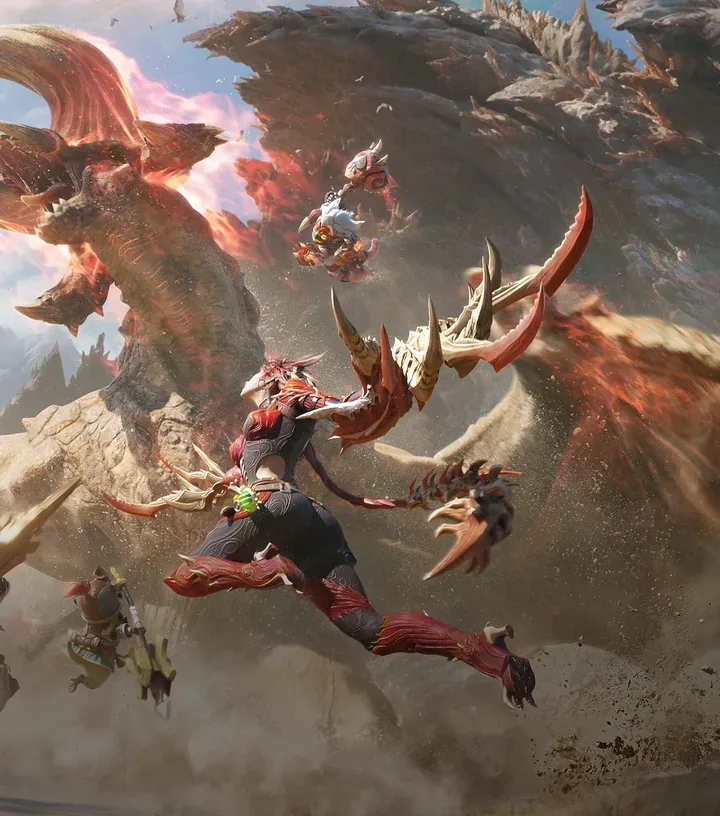
Monster Hunter Outlanders supports real-time hunts for up to four players. Bring a mix of Assault, Disruptor and Support Adventurers, break a part together to trigger co-op skills, and use guilds or fixed teams for repeat runs. Crossplay between iOS and Android has not been clearly confirmed.
Field note
Party size and matchmaking
Outlanders supports up to four players in real-time co-op. You can hunt alone in the open field or form a squad for harder encounters. Official materials describe single-tap squad formation, making drop-in co-op a core part of the design.
Matchmaking specifics may change at launch. Use the in-game room system for random groups and a fixed team or guild for repeated material farms. A coordinated squad with a plan is worth more than four players chasing separate health bars.
Field note
Assault, Disruptor and Support
The three Adventurer classes describe what a character brings to a hunt. Assault focuses on damage, Disruptor on control and weakening, and Support on healing and buffs. A good squad does not need one of each, but it should cover part breaks, sustain and a safe way to handle the monster's strongest phase.
The Fated Adventurer can fill any gap because they can use every weapon. If your group already has two damage dealers, bring a shield or a support tool instead of another glass-cannon build.
| Class | Primary job | Good squad fit |
|---|---|---|
| Assault | Damage and part breaks | Pyro, Luka, Midori, Ouyang Varen |
| Disruptor | Control, status and interruptions | Keres, Raya, Pepper, Freya |
| Support | Sustain, buffs and safer windows | Arkaya, Madelyn |
| Fated | Any role depending on weapon | Your custom hunter |
Field note
How co-op skills work
Outlanders rewards coordinated attacks with a co-op skill system. The exact trigger is tied to attacking a broken part within a short window as a group. In practice, call out the part you are breaking, then save your burst for the moment it breaks instead of spending everything on the approach.
This is why a ranged player and a melee player can be more valuable together than two identical damage builds. The ranged player creates the opening or breaks the wing; the melee player cashes the topple on the head.
Squad rule
Announce the break target before the hunt. Everyone hitting one part is worth more than four private damage races.
Field note
Guilds and fixed teams
Guilds support larger groups and weekly challenge content. Fixed teams are useful for material farms because they cut the coordination cost of every hunt. If you are playing with the same group regularly, agree on roles and a short callout vocabulary.
For guild play, bring a build that covers a weakness rather than only your personal best damage. A consistent Support or shield player can raise the whole group's clear rate.
Field note
Crossplay, cross-save and platforms
The game launches on iOS and Android. Crossplay between those platforms has not been clearly confirmed in public materials, and cross-progression should be treated as unconfirmed until the live account guidance is published. There is no announced PC or console version.
If you plan to play with friends, confirm that you can actually invite them across your device and region combination before building a fixed group around it. For a more detailed platform breakdown, see our system requirements guide.
Field note
Co-op etiquette that wins hunts
Do not wake a sleeping monster with a weak hit if a heavy hitter is charging. Do not stand on the opposite side of the map and expect support. Do not use a long animation when the monster is about to enrage. Most failed co-op hunts are coordination failures, not damage failures.
- Break the part your squad called, not the part closest to you.
- Leave the head to blunt and heavy weapons when possible.
- Bring your own healing; do not rely on the Support player as a safety net.
- Use voice or quick chat to call co-op skill windows and dangerous phases.
Quick answers